More Than Entertainment: YouTube as a Social Learning Platform
Platform Choice & Justification
YouTube has become much more than a platform for entertainment; it is also a valuable resource for learning new skills, sharing knowledge, and connecting with others. I chose YouTube for my social learning platform analysis because of how frequently I rely on it, particularly while restoring my 1978 Ford Bronco. Before beginning this project, I had virtually no automotive experience, which made learning unfamiliar procedures challenging. Although I own detailed repair manuals, they often use technical terminology or reference tools and components I do not recognize. YouTube helps bridge this gap by allowing me to watch someone physically demonstrate a repair while explaining each step. Being able to pause, rewind, and follow along at my own pace has made learning these skills considerably easier.
Beyond tutorials, YouTube encourages social learning by allowing users to share knowledge, ask questions, and exchange advice through its comment sections. However, despite these benefits, I have also noticed limitations in how the platform supports meaningful interaction and helps users determine whether the information they encounter is reliable.
Analytical Framework
To evaluate YouTube as a social learning platform, I developed four criteria based on theories and concepts covered throughout the course. I chose these criteria because I believe an effective social learning platform should not only provide educational content but also accommodate different learning needs, encourage meaningful interaction, and help users evaluate the information they encounter.
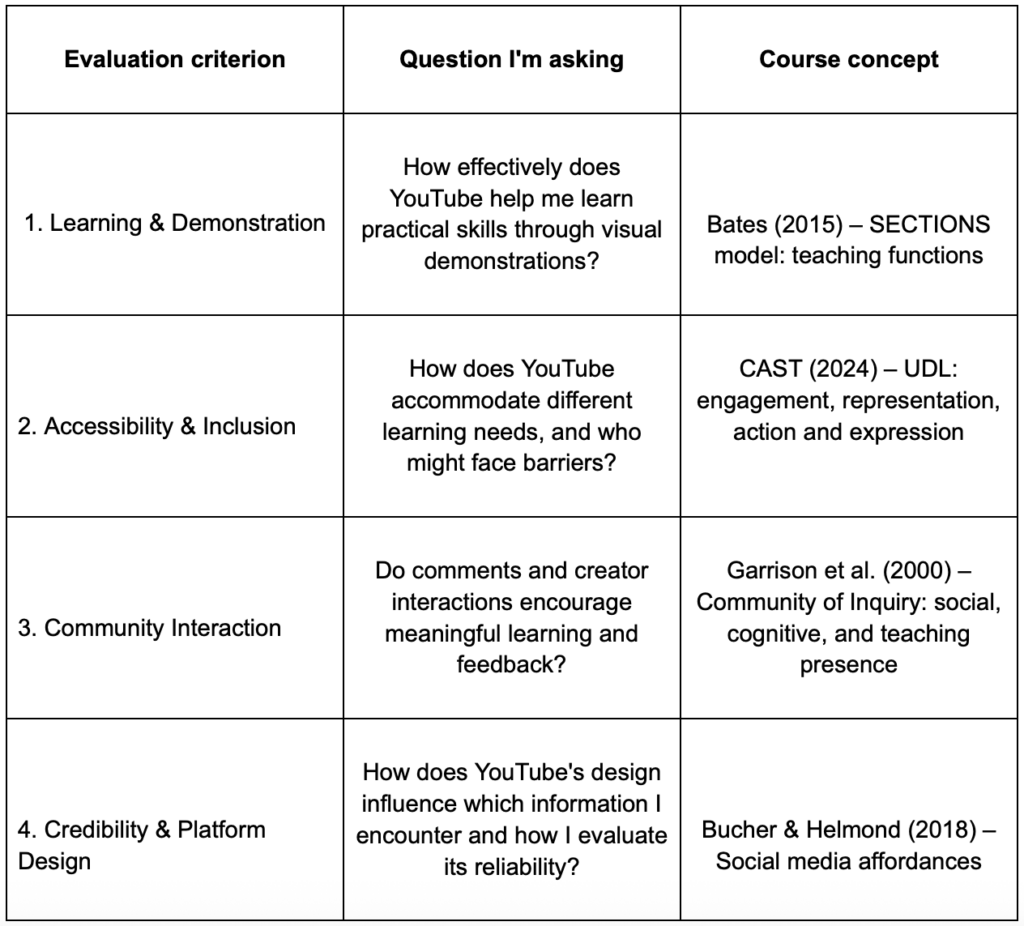
These four criteria allow me to examine YouTube from different perspectives. Bates (2015) and CAST (2024) help me evaluate how accessible and effective the learning experience is, while Garrison et al. (2000) and Bucher and Helmond (2018) help me consider how community interactions and platform design influence learning. Together, these theories demonstrate that providing access to educational videos is not necessarily the same as creating an effective social learning environment. I will evaluate each criterion using a five-point scale, where 1 represents significant limitations and 5 represents strong support for social learning. My scores will consider both my personal experiences and specific examples from YouTube.
Platform Analysis
Learning and Demonstration – 5/5
One of YouTube’s greatest strengths is its ability to make complicated procedures easier to understand through visual demonstrations. When restoring my Bronco, I frequently encounter unfamiliar terminology, tools, and components in repair manuals. Although these manuals provide detailed instructions, they often assume a level of knowledge I have not yet developed. YouTube helps bridge this gap by allowing me to observe how tools are used and how individual steps are performed. I can pause, rewind, and compare what I see with the work I am doing myself, rather than relying entirely on written descriptions. This connects to Bates’ (2015) SECTIONS model, particularly the importance of matching educational media to specific teaching functions. While written instructions provide detailed information, video demonstrations can make practical procedures easier to visualize and follow. However, the quality of learning ultimately depends on the accuracy and clarity of the creator’s explanations.
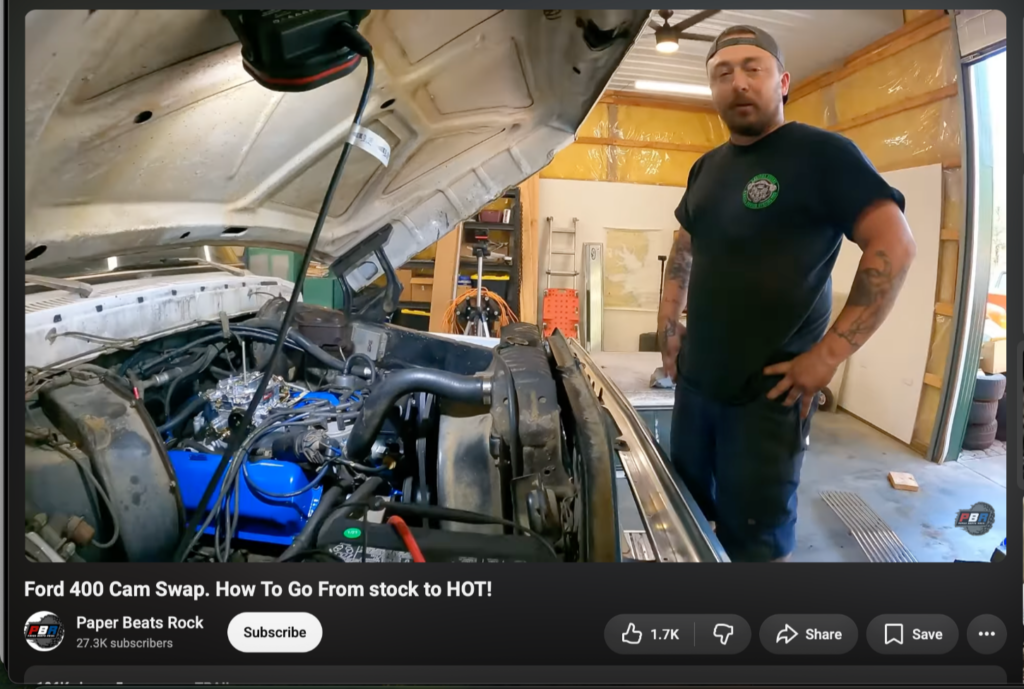
YouTube tutorial demonstrating an engine repair, allowing viewers to observe the tools and techniques being used.
Accessibility and Inclusion – 4/5
I find YouTube particularly accessible because of its straightforward interface and the flexibility it provides when watching videos. I frequently increase playback speed to move through less relevant explanations, while clearly labelled chapters help me locate specific procedures without watching an entire tutorial. YouTube also provides captions and audio settings, as shown in Figure 2. These features align with CAST’s (2024) Universal Design for Learning guidelines by offering multiple ways to access and engage with information. However, I recognize that what I find convenient may not be equally effective for everyone. Automatic captions can misinterpret technical terminology, potentially confusing learners who depend on them. Similarly, individuals with limited internet access or digital literacy may face barriers. This demonstrates that providing accessibility features does not necessarily guarantee an inclusive learning experience.
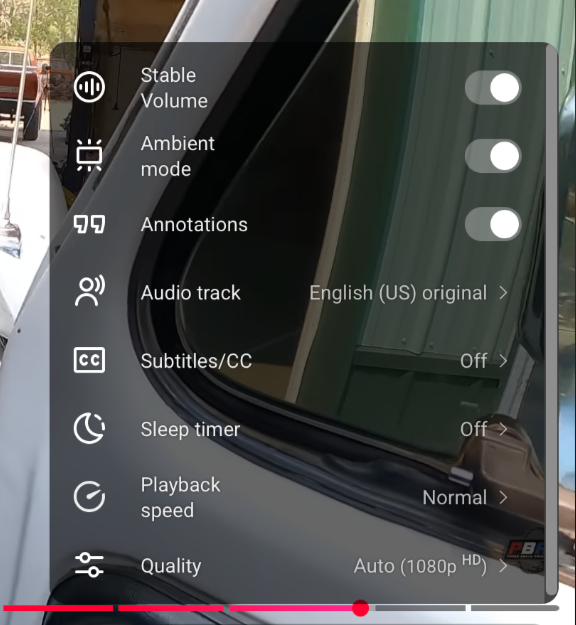
YouTube’s playback settings, showing options for subtitles, playback speed, and audio adjustments.
Community Interaction – 3/5
Beyond the videos themselves, I find YouTube’s comment sections valuable because they allow viewers to contribute knowledge that the original creator may have overlooked. When watching automotive tutorials, I often encounter comments recommending alternative tools, suggesting easier techniques, or correcting inaccurate information. Figure 3 illustrates this through viewers sharing technical details and asking questions about engine repairs. These interactions connect to Garrison et al.’s (2000) Community of Inquiry framework, particularly social and cognitive presence, as individuals contribute their experiences and help others develop a deeper understanding. However, YouTube’s asynchronous comment sections do not guarantee meaningful interaction. I have encountered questions that remain unanswered for years, leaving learners without the clarification they need. This highlights the difference between providing opportunities for discussion and actually supporting collaborative learning.

YouTube comment section showing viewers sharing technical information, correcting misconceptions, and asking questions about automotive repairs.
Credibility and Platform Design – 2/5
One of my biggest criticisms of YouTube is its decision to hide publicly visible dislike counts. Previously, I used the ratio of likes to dislikes as a quick indication of how other viewers responded to a tutorial. Without this information, I increasingly rely on comments, particularly those confirming that a procedure worked or identifying problems with the instructions. As shown in Figure 4, YouTube displays the number of likes while withholding the total number of dislikes. This connects to Bucher and Helmond’s (2018) discussion of platform affordances, as interface design influences which forms of community feedback users can access. Although dislike counts were never a definitive measure of accuracy, their removal limits one way learners can evaluate unfamiliar content. I have also noticed that watching just a few automotive videos fills my recommendations with similar content. While this sometimes introduces useful tutorials, it can also prioritize familiar or unrelated content over alternative explanations. Together, these design choices demonstrate how YouTube influences not only what learners discover but also how they judge the reliability of what they encounter.

YouTube’s like and dislike interface, showing that public like counts remain visible while dislike counts are hidden.
Reflection & Implications
Overall, this analysis has strengthened my understanding of YouTube as a social learning platform, particularly how its design can both support and limit learning. Through my experience restoring my vehicle, I have seen firsthand how valuable visual demonstrations can be when developing unfamiliar skills. YouTube has allowed me to approach complicated repairs with greater confidence, providing free, accessible tutorials that I can revisit whenever necessary.
However, I have also come to recognize that having access to educational content does not necessarily guarantee meaningful learning. Bates’ (2015) SECTIONS model highlights the importance of choosing technologies that support specific learning activities, while Garrison et al.’s (2000) Community of Inquiry framework emphasizes the role of interaction and feedback in developing understanding. Although YouTube supports both, its comment sections do not always provide the timely or reliable guidance learners may need.
My analysis also made me consider how differently people experience the platform. While I find YouTube relatively straightforward to navigate, individuals with limited digital literacy or background knowledge may struggle to distinguish accurate information from misinformation. Furthermore, personalized recommendations influence which content learners encounter, while the removal of public dislike counts limits one form of community feedback available to evaluate videos. Although this decision may help protect creators from targeted negativity, it also creates challenges for viewers attempting to assess credibility.
Ultimately, YouTube demonstrates that access to information and effective learning are not necessarily the same thing. This extends beyond YouTube to other social learning platforms, where accessibility, meaningful interaction, and the ability to critically evaluate information are essential for creating valuable learning experiences.
References
Bates, A. W. (2015). Teaching in a digital age: Guidelines for designing teaching and learning. Tony Bates Associates Ltd. https://opentextbc.ca/teachinginadigitalage/
Bucher, T., & Helmond, A. (2018). The affordances of social media platforms. In J. Burgess, A. Marwick, & T. Poell (Eds.), The SAGE handbook of social media (pp. 233–253). SAGE Publications. https://doi.org/10.4135/9781473984066.n14
CAST. (2024). Universal Design for Learning guidelines version 3.0. https://udlguidelines.cast.org/
Garrison, D. R., Anderson, T., & Archer, W. (2000). Critical inquiry in a text-based environment: Computer conferencing in higher education. The Internet and Higher Education, 2(2–3), 87–105. https://doi.org/10.1016/S1096-7516(00)00016-6